Why did you want to study in the US?
The US got under my skin early. My brother did a high-school exchange year when he was seventeen, and I was fourteen when we went to visit him. It was my first time in America. Everything was so big: the roads, the portions, the ambition. Florida, Atlanta, New Orleans, all in one trip. I remember thinking, this is a different scale of living.
The real pull came later, though, and it was about science. At twenty-two I did a six-month research internship at Harvard Medical School in a sleep lab, and I fell in love with how research worked there. It was fast, it was interdisciplinary, and people from very different fields sat in the same room solving the same problem. Nobody waited for permission to collaborate. I knew I wanted to do my PhD in that kind of environment.
Then my internship advisor, Matt Walker, left Harvard to start his own lab at UC Berkeley. That was my opening: a PhD in the field I loved, sleep, in a brand-new lab, in a new place. The NAF-Fulbright made it possible.
Talk me through your early journey of arriving at UC Berkeley and your initial impressions of the US.
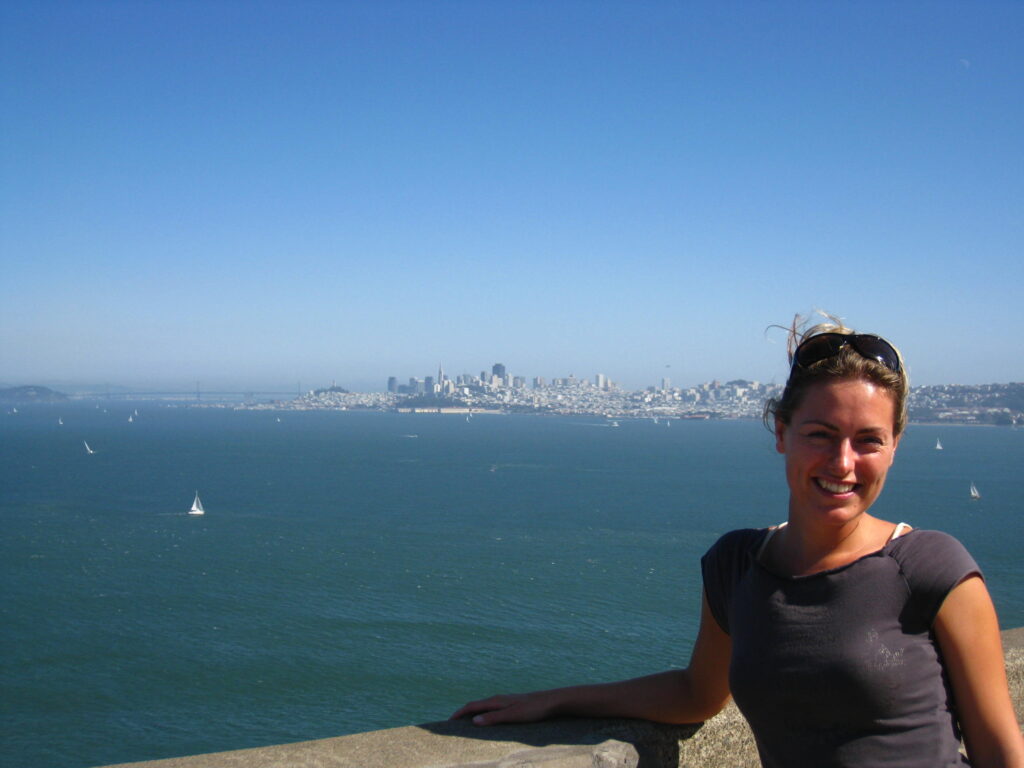
I arrived in August 2008, twenty-four years old, after an eighteen-hour journey and almost a year of admission tests, letters and interviews. I know the details because I wrote a column about my American life for the newspaper back home in Friesland, De Stellingwerf, and I recently dug those columns up. For the first one I had looked everything up: Berkeley is exactly 8,788 kilometres from my village, nine hours behind, and 34,900 of its 90,000 residents are students. My whole village was reading along, so I couldn’t start with factual errors.
I felt at home almost immediately, and I think that had a lot to do with how a PhD program throws you into community. Within days I had classmates, a full schedule, labmates, and a house with two psychology students, two working girls and a sixty-five-year-old landlady who was the prototype Berkeley hippie and had an Obama sign in the front yard. I wrote home: imagine a sign for Balkenende in your garden. Four social circles, instantly. That is rare when you move abroad as an adult.
Then the small things. My Philips wake-up light, the pride of Dutch design, couldn’t cope with American voltage and turned into a dim mood lamp. That turned out to be a blessing, because Americans put fluorescent tube light everywhere: living rooms, bathrooms, restaurants. Even IKEA didn’t dare sell a matte lamp. Funny in hindsight, given that light and sleep are now my profession. The bike shop wanted to sell me a bike on which my feet touched the ground, and nobody had ever heard of taking someone on the back. I bought the big frame, twenty-seven gears, which on those hills is no luxury, and insisted on the largest basket in the shop. When I cycled to a barbecue with two bowls of salad and a bottle of wine, people were amazed.
And then election night, November 2008. Berkeley erupted. The next morning at nine I had to teach my sections of “The Science of Sleep”, and every student came in late and bleary. I told them it was the only day in four years they were allowed to be late.
Is there an element of American culture that has stayed with you that you learned during your Fulbright year?
My program was five years in total, so the US shaped me in more ways than I can list, but three things stand out.
The first is how normal it was to change direction. In the Netherlands, a career switch still needs explaining. In the US, people I admired had been a lawyer, then a founder, then a professor. That openness gave me the courage to leave academia after my PhD and join McKinsey, because I was curious about the problems businesses were wrestling with. Funnily enough, the switch brought me back to sleep, now with my own company, working with organizations on how sleep drives performance and leadership.
The second is the instinct to build something when you see a gap. Being an hour from Silicon Valley does that to you. I saw that PhDs and postdocs had almost no idea what careers existed outside the university, so with a few fellow students I started a conference at Berkeley called Beyond Academia. It’s still running today, more than a decade later, which makes me very proud.
The third is the American conviction that science belongs to everyone. At Berkeley, translating your findings to the public was part of the job, through outreach, media, talks. And there was a real focus on helping all of society, not only people who look like you. That thinking runs through everything I do now, from my keynotes and workshops to my book, Sleep Intelligence, which comes out in January. I made sure it speaks to shift workers and parents of young children, not only to executives with a corner office.
How did you bring your own Dutch culture to the US?
Sinterklaas, every single year. It started in my first autumn, when my family sent a Sinterklaas parcel across the ocean: pepernoten, schuimpjes, chocolate letters, even chocolate cigarettes. I shared it with my housemates and something clicked. From then on I hosted a Sinterklaas evening at Berkeley every December, with Dutch treats and a lot of explaining. My American and international friends were baffled at first and then completely hooked.
The other thing I did, together with fellow Fulbrighter Zdena op de Macks, was organize Fulbright Bay Area dinners. We brought together Fulbright students from all over the world who were spread across Berkeley, Stanford, UCSF and the other universities in the area. Those evenings were some of my favorite memories of the whole five years, and Zdena is still one of my closest friends.
How did receiving the NAF-Fulbright affect your professional trajectory?
It was the hinge of my career. Without it, I don’t think I would have done my PhD in the US, and everything since flows from those five years.
I should confess that I nearly didn’t get it. The Fulbright committee grilled me so thoroughly that I called my parents afterwards to tell them I had certainly failed. Apparently the committee was rather impressed. And I told the local newspaper at the time, with all the confidence of a twenty-four-year-old, that “with a Fulbright on your CV, doors open for you.” Eighteen years later I can confirm that this was true.
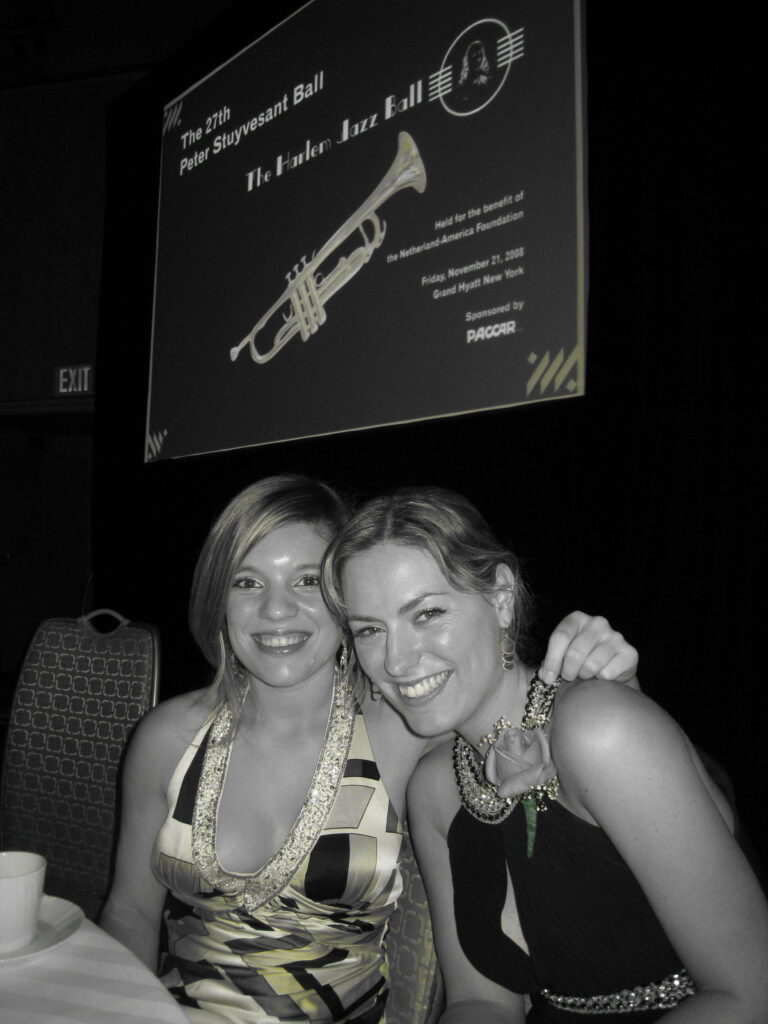
The NAF also gave me my first taste of what those doors look like. In my first November, I was invited to the Peter Stuyvesant Ball in New York, wearing a rose as a scholarship recipient. A friend and I went shopping for a ball gown in San Francisco, and when the saleswoman asked who our favourite designer was, I answered “a cheap one?” The dresses started at two thousand dollars. We found something within a student budget, saw Princess Margriet and Pieter van Vollenhoven, and watched Ayaan Hirsi Ali dance without bodyguards. Then I took a fourteen-hour train-and-car journey to Pennsylvania to spend my first Thanksgiving with an American family. That’s the NAF in one weekend: a Dutch network at the very top, and a door into ordinary American life.
At Berkeley I studied what sleep does for the brain: how it consolidates what we learn, and how it regulates emotion. Some of my own research showed that a sleep-deprived brain becomes worse at reading emotions in other people’s faces, and that REM sleep helps take the emotional edge off difficult experiences. Those findings are still at the core of what I teach leaders today, because a leader who has slept four hours is, quite literally, reading the room wrong.
The American permission to switch tracks took me to McKinsey for two and a half years, where I learned how organizations actually make decisions. And the American instinct to translate science into something people can use is why I now run my own company, speaking to and advising organizations such as Meta, Novartis, L’Oréal and PwC on sleep, performance and leadership, and why I wrote Sleep Intelligence.
And then there are the people. Some of my closest friendships, and a few of my most valuable professional relationships, started at those Bay Area dinners.
The academic year just started and new Fulbright students have arrived, likely gearing up for all-nighters alongside lots of caffeine. What is your advice for students who want to perform their best this year?
Please don’t pull the all-nighter. I know that sounds rich coming from someone who did a PhD, and who in her first semester at Berkeley taught three sections of “The Science of Sleep” while, judging by my old columns, not always practising what she taught. But the science is unambiguous. The night after you learn something is when your brain files it away. Skip that night’s sleep and a large part of what you studied never makes it into long-term memory. You are cramming into a bucket with a hole in it.
Three things I’d tell every new Fulbrighter:
- First, protect your sleep window the way you would protect a lecture you can’t miss. Seven to nine hours, most nights, at roughly the same times. Consistency matters as much as quantity; a regular rhythm makes every hour of sleep work harder for you.
- Second, treat caffeine as a tool with a timing rule. It has a half-life of five to six hours, so a coffee at four in the afternoon is still a quarter of a coffee at ten at night. Enjoy it in the morning, stop by early afternoon.
- Third, remember that sleep is also how you stay emotionally steady. Your year abroad will have hard weeks: homesickness, imposter feelings, a supervisor’s blunt feedback. A rested brain handles those with perspective; a sleep-deprived brain catastrophizes. My own research showed exactly that. So on the nights you’re tempted to push through, ask yourself which version of you needs to show up tomorrow.
And a small thing that is really a big thing: the friendships you make this year are the part you’ll still be living on twenty years later. Those need a rested, present you too.
To learn more about Els, visit elsvanderhelm.com. Her book, Sleep Intelligence, is out 12 January 2027 (US: Dutton / Penguin Random House; UK: Torva; NL: Slaapintelligentie, Unieboek | Het Spectrum).
Our Sponsors